
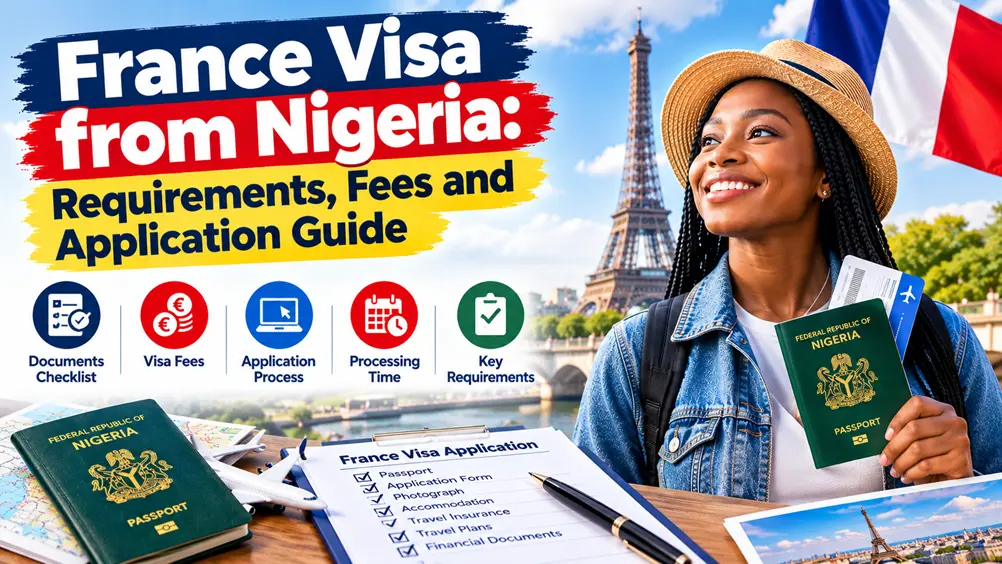
Planning a trip to France from Nigeria requires more than booking a flight and preparing an itinerary. You need to determine the right visa category, prepare the required documents, complete the France-Visas application, book your appointment and submit your application through the designated visa centre. For most Nigerians travelling to France for tourism, family visits or other short trips, the relevant visa is a short-stay Schengen visa, which generally allows stays of up to 90 days in a 180-day period. This guide explains the main requirements, fees, application process and processing timeline for a France visa from Nigeria.
Do Nigerians Need a Visa to Visit France?
Yes. Nigerian passport holders generally need a visa to enter France for a short visit. The type of visa you need depends on the purpose and length of your trip. A short-stay Schengen visa is generally used for tourism, business trips, family visits and other eligible stays of up to 90 days. If you intend to stay in France for more than 90 days, you will generally need a long-stay visa instead.
If you are travelling to several Schengen countries, you should not automatically apply through France simply because France is the first country you will fly into. France should generally be your sole or main destination based on the purpose or duration of the trip.
France Visa Requirements for Nigerians
The exact documents required depend on your purpose of travel and personal circumstances. France-Visas generates a personalized document list based on the information you provide during the application process.
However, applicants should generally expect to provide the following documents:
- Valid Nigerian Passport: Your passport should be in good condition, have been issued less than 10 years ago and contain at least two blank pages. For a short stay, France-Visas states that the passport should remain valid for at least three months beyond your expected departure from the Schengen Area. You will normally provide the original passport and a copy as part of your application.
- Completed France Visa Application: You need to complete the appropriate online application through the official France-Visas platform. After completing the application, you should print the required application documents, including the final application form and receipt, and take them to your appointment.
- Recent Passport Photograph: Applicants need recent identity photographs that meet the required ICAO specifications. The France-Visas process specifies two recent ID photos as part of the application preparation.
- Proof of Accommodation: You need to show where you will stay during your trip. Depending on your circumstances, this could include a hotel reservation or, if you are staying with someone in France, the relevant accommodation documentation. Proof of accommodation is also among the documents that French border authorities can request when you arrive.
- Proof of Sufficient Funds: You need to demonstrate that you have enough money to support yourself during the trip. For entry into France, the official guidance currently specifies €65 per day when you have a hotel booking and €120 per day when you do not have a hotel booking. Different rules apply if you are hosted by an individual with the appropriate accommodation certificate. For Nigerian applicants, the financial documents submitted should also make sense in relation to your personal circumstances, employment, income and proposed trip. For a detailed explanation of the financial side of a France application, see our guide to France Tourist Visa Requirements.
- Travel Medical Insurance: Travel insurance is required for short-stay tourism and business trips unless an exemption applies. France-Visas states that the insurance must cover at least €30,000 for medical and hospital expenses, emergency treatment and medical repatriation, and must be valid throughout the applicable Schengen territory for the duration of the stay.
- Proof of Your Travel Plans: Your application should clearly explain why you are travelling to France and what you intend to do during the trip. Depending on the circumstances, this may include an itinerary, accommodation arrangements, evidence of planned activities or documents explaining the purpose of your visit. The information across your application should be consistent. Your travel dates, accommodation, financial evidence and stated purpose should tell the same story.
- Evidence of Your Situation in Nigeria: Applicants may need documents that demonstrate their personal, professional or financial circumstances. For an employed applicant, this could include employment-related documents and approved leave. A business owner may provide relevant business documents, while a student may provide evidence of enrollment and supporting documents from their institution. The exact requirements depend on the applicant’s circumstances, which is why the France-Visas document checklist should be used rather than relying on a generic list alone.
France Visa Fees in Nigeria
The standard French visa application fee is currently:
- €90 for a short-stay Schengen visa
- €99 for a long-stay visa
- €45 for children aged 6 to under 12 for applicable short-stay visas
- Children under 6 are generally exempt from the standard visa fee
There is also a TLScontact service fee of €28, payable online according to the French official exchange rate. The visa fee is paid in local currency by card at the application centre, according to the current TLScontact instructions. Visa fees and TLScontact service fees are generally non-refundable if the application is refused or withdrawn. For a more detailed breakdown, see France Visa Fee in Nigeria.
How to Apply for a France Visa from Nigeria
The application process has several stages.
- Determine the Correct Visa: Start with the official France-Visas website and provide information about your nationality, purpose of travel, intended stay and other relevant circumstances. The system helps determine whether you need a visa and which type is appropriate.
- Complete the Online Application: Complete your application through France-Visas and provide the requested information. You should take care when entering your personal information because details such as your name, passport number, travel dates and other information need to correspond with your supporting documents.
- Prepare Your Supporting Documents: Use the document checklist generated through the France-Visas application process. Arrange the documents in the required order and prepare both originals and copies as instructed for applications in Nigeria. TLScontact’s current Nigeria guidance asks applicants to bring one set of original documents and one set of A4 photocopies. Documents submitted to the French consular services in Nigeria must be in English or French. Documents in another language must be accompanied by an appropriate translation into English or French.
- Book Your TLScontact Appointment: After completing the France-Visas application, you need to book an appointment through TLScontact. The appointment is compulsory for applicants using the normal application process in Nigeria and includes prepayment of the TLScontact service fee. There are TLScontact visa application centres in Lagos and Abuja, although applicants should check the current France-Visas Nigeria instructions before selecting a centre because the services available at each location can change. As of the current France-Visas guidance, TLScontact Abuja has restrictions on the categories of applicants it receives, while Lagos handles the wider range of applications.
- Attend Your Appointment: Applicants generally need to attend in person. France issues biometric visas, and applicants aged 12 and above are required to provide a photograph and fingerprints. In some cases, previously collected biometric data can be reused where a previous Schengen biometric visa was issued less than 59 months earlier. You will also submit your passport and supporting documents at the appointment.
- Track Your Application: Once your application has been submitted, you can track its progress through the relevant visa centre. The consular authorities, rather than TLScontact, make the final decision on the visa application. Applications submitted in Nigeria are processed by the Consular Section of the French Embassy in Abuja and the Consulate General of France in Lagos.
How Long Does a France Visa Take in Nigeria?
The general France-Visas guidance states that visa decisions are usually made within 15 days, although this can be extended to 45 days in special cases when additional examination is required. However, applicants in Nigeria are specifically advised to allow more than one month between submitting a short-stay application and their planned departure date. For long-stay applications, France-Visas advises allowing at least two months. Applications can be submitted up to six months before travel. For a fuller explanation, see France Visa Processing Time in Nigeria.
Where to Submit a France Visa Application in Nigeria
France visa applications are submitted through TLScontact centres in Nigeria.
The current France-Visas information lists:
Lagos:
1st Floor, Banksome House
39 Adeola Odeku Street
Victoria Island, Lagos
Abuja:
Ground Floor, Murkhtar El-Yakub Square, next to Metro Plaza
Zakariya Maimalari Street
Central Business District, Abuja
However, applicants should always check the current France-Visas Nigeria page before attending because opening arrangements and eligibility for particular centres can change.
What Happens After Your France Visa Is Approved?
If your application is approved, you will receive your passport with the visa affixed to it. Before travelling, check the information on the visa carefully, including:
- Your name
- Passport number
- Visa validity dates
- Number of entries
- Duration of stay
Remember that having a visa does not automatically guarantee admission into France. French border authorities can request documents relating to your accommodation, financial means, travel purpose, return arrangements and insurance when you arrive. This is why you should keep important supporting documents available during your journey.
What If France Is Not Your Main Schengen Destination?
This is an important point that applicants sometimes overlook. If your trip covers several Schengen countries, you should apply through the country that is your main destination, determined primarily by the duration or purpose of your stay. For example, if you spend five days in France and fifteen days in Italy, Italy would generally be the responsible country for the visa application because it is the main destination in terms of duration. If France is your main destination but you enter the Schengen Area through another country, you can still apply through France.
Applying through a country simply because it appears easier, while your actual main destination is elsewhere, can create problems with the application.
Frequently Asked Questions
How much is a France visa from Nigeria?
The standard short-stay Schengen visa fee is currently €90, while the standard long-stay visa fee is €99. Applicants in Nigeria also pay a TLScontact service fee of €28, with the local-currency amount determined using the French official exchange rate.
How long does it take to get a France visa in Nigeria?
The general decision-making period is usually 15 days and can extend to 45 days in special cases. However, France-Visas specifically advises applicants in Nigeria to allow more than one month between submitting a short-stay application and planned departure.
Can I apply for a France visa six months before travelling?
Yes. France-Visas says applicants can submit their application up to six months before their planned travel date.
Do I need travel insurance for a France tourist visa?
Yes. Travel insurance is required for short-stay tourism and business trips unless an applicable exemption exists. France-Visas specifies minimum coverage of €30,000 for medical and hospital expenses, emergency treatment and repatriation.
Do I need to attend a France visa appointment in person?
Applicants generally need to appear in person at the TLScontact centre in Nigeria. Applicants aged 12 and above also provide biometric data, although previously collected fingerprints may in some circumstances be reused if they were taken for a previous Schengen visa application less than 59 months earlier.
Can I apply for a France visa if I am visiting other Schengen countries?
Yes, provided France is the country responsible for your application based on the rules for determining the main destination. If another Schengen country is your main destination, you should normally apply through that country instead.
Does having a France visa guarantee entry into France?
No. A visa allows you to travel to a French border crossing and request admission, but border authorities can still check your purpose of travel, accommodation, financial means, return arrangements and other entry conditions.
Conclusion
Applying for a France visa from Nigeria involves several stages, from selecting the correct visa category and completing the France-Visas application to preparing your documents, attending a TLScontact appointment and waiting for the consular decision. For a short tourist trip, the key things to get right are your purpose of travel, supporting documents, accommodation, financial evidence, travel insurance and application timing. You should also leave enough time between your application and intended departure, particularly because France-Visas currently advises applicants in Nigeria to allow more than one month for short-stay applications.
If you are preparing your application, our supporting guides can help with the individual parts of the process:
- France Visa Requirements for Nigerians
- How to Apply for France Visa from Nigeria
- France Visa Fee in Nigeria
- France Tourist Visa Requirements
- France Visa Processing Time in Nigeria
Together, these guides cover the major questions applicants are likely to have before submitting a France visa application.
However, if you still want expert guidance and support, feel free to contact us and we will handle the whole process for you.